DevOps Automation Retainer
DevOps Automation Retainer
Slow, manual deployments are an engineering tax. Every week your team spends on deployment coordination, environment debugging, and incident fire-fighting is a week not spent shipping features.
I’ve helped teams move from manual, error-prone release processes to automated CI/CD pipelines that significantly reduce deployment overhead. This retainer keeps that momentum going.
The Real Cost of Broken DevOps
Beyond the obvious frustration, broken DevOps has measurable costs:
- Engineering time — Senior engineers spending Friday afternoons on manual deploys instead of architecture work
- Incident frequency — Without proper staging parity and automated rollbacks, production incidents become routine
- Developer velocity — Long CI pipelines and flaky tests create feedback loops that slow down every PR
- Onboarding friction — New engineers take weeks to understand how to get code to production
- Cloud waste — Poorly configured pipelines spin up ephemeral environments that never get torn down
Most of these problems are solved once, correctly, and maintained — not re-solved every quarter.
What’s Included in the Retainer
CI/CD Pipeline Engineering
Design, build, and maintain automated pipelines that go from code push to production safely.
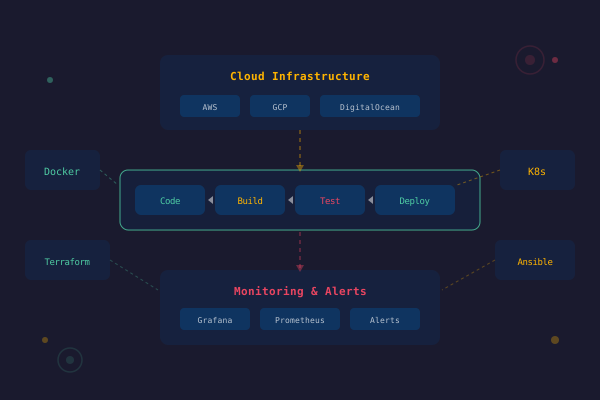
- Multi-stage pipelines: build → test → security scan → staging → production
- Branch-based deployment rules (feature branches to ephemeral envs, main to staging, tags to production)
- Automated rollback on health check failure
- Build cache optimization for faster pipeline execution
- Secrets management via AWS Secrets Manager, GitHub Secrets, or Vault
Tooling: GitHub Actions, GitLab CI/CD, AWS CodePipeline, Docker, AWS ECR/ECS
Infrastructure as Code
Version-controlled infrastructure that can be reproduced, reviewed, and audited.
- Terraform modules for AWS resources (VPC, ECS, RDS, S3, CloudFront, ALB)
- Environment parity — staging mirrors production configuration, not a watered-down approximation
- Drift detection and remediation
- Infrastructure change review as part of the PR process
Kubernetes & Container Orchestration
Production-grade container management for teams that have outgrown simple deployments.
- EKS/self-managed Kubernetes cluster setup and hardening
- Helm chart development and management
- ArgoCD GitOps workflow implementation
- Horizontal Pod Autoscaler and resource limit tuning
- Multi-environment namespace strategy
Observability & Alerting
You can’t fix what you can’t see.
- Prometheus + Grafana stack for infrastructure and application metrics
- OpenTelemetry instrumentation for distributed tracing
- CloudWatch dashboards and log insights for AWS-native visibility
- Alert routing — critical pages on-call, warnings to Slack, not everything is a page
- Runbook documentation for common incident patterns
Ongoing Maintenance
The retainer covers the work that keeps the pipes clean:
- Dependency and base image updates (security patches)
- Pipeline performance optimization as codebase grows
- New service onboarding to existing CI/CD standards
- Incident post-mortems and pipeline improvements
- Monthly DevOps health report
One-Time Setups (Non-Retainer Option)
Not ready for a retainer? I offer fixed-scope setup engagements:
- CI/CD Pipeline Setup — Single project, one pipeline, deployed and documented. 1–2 week delivery.
- Full DevOps Bootstrap — CI/CD + IaC + monitoring stack for a new product or team. 3–5 week delivery.
- Kubernetes Migration — Moving from ECS or bare EC2 to Kubernetes with zero-downtime cutover plan.
Proven Results
- Deployment automation — Multiple clients moved from bi-weekly manual releases to automated same-day deployments using GitHub Actions and GitLab CI/CD
- Incident reduction — Automated testing and staging environment parity reduced production deployment issues
- Automated pipelines — Built CI/CD workflows for projects at G2Academy, using GitHub Actions and Jenkins
- Zero-downtime deployments — ECS blue-green deployments for financial services client during business hours
Retainer Options
-
Starter Retainer — 20 hours/month. Covers one active project: pipeline maintenance, dependency updates, and incident support. Best for small teams with a stable, working pipeline.
-
Growth Retainer — 40 hours/month. Covers 2–3 services: active pipeline development, IaC management, observability improvements, and new service onboarding.
-
Scale Retainer — 80 hours/month. Full DevOps engineering support: Kubernetes management, multi-environment IaC, on-call escalation support, and quarterly architecture review.
Minimum engagement: 3 months. All retainers include a monthly written summary of work done, changes deployed, and upcoming recommendations.
Who This Is For
- Engineering teams shipping features but spending too much time on deployment coordination
- CTOs who want a senior DevOps engineer without a full-time hire
- Startups that have outgrown Heroku or Render and need proper AWS infrastructure
- Teams preparing to scale and needing CI/CD before the next growth push
- Companies with cloud costs growing faster than their user base (pipeline inefficiency is often a hidden factor)
Why Work With Me
- Former AWS Authorized Instructor (2022–2025) — I understand AWS infrastructure at the level needed to build pipelines that stay cost-efficient
- 5 AWS certifications achieved — including SysOps Administrator, covering operational reliability
- 10+ years of production systems — I’ve seen what breaks at scale and designed pipelines that don’t
- Backend engineer by background — I write infrastructure code with the same standards as application code: readable, tested, documented
- Async-first — detailed written handoffs, documented decisions, no knowledge hoarding
Next Step
Tell me: how many services do you have, how often do you deploy today, and what’s the biggest pain point in your current process? I’ll come back with a realistic scope for where to start.
Contact: toni@kusnandar.dev or LinkedIn
Pertanyaan yang Sering Diajukan
-
What does deployment automation look like in practice?
- On a real engagement: a team going from 2-week manual release cycles (SSH into server, run scripts, hope nothing breaks) to same-day automated deployments via GitHub Actions → AWS ECS. No more deployment windows, no more weekend deploys. Every push to main triggers build, test, staging deploy, and production deploy with approval gate — in under 15 minutes.
-
We already have some CI/CD setup. Can you improve it rather than start from scratch?
- Yes, and that's often the right approach. I'll audit what you have, identify the gaps causing slowdowns or incidents, and improve incrementally. Starting from scratch is only recommended when the existing setup is causing more problems than it's solving.
-
What's the difference between the one-time setup and the retainer?
- The one-time setup gets you a working pipeline. The retainer keeps it healthy as your stack evolves — new services, new environments, dependency updates, incident response, and ongoing optimization. Most teams underestimate how much ongoing DevOps work there is once the pipeline is live.
-
Do you work with teams that aren't on AWS?
- Yes. I have production experience with AWS (primary), GCP, and DigitalOcean. The principles and tooling (Docker, Kubernetes, Terraform, GitHub Actions) transfer across providers. I'll tell you upfront if a specific platform is outside my depth.
Technologies