High-Performance Backend Engineering
High-Performance Backend Engineering
Most backend performance problems aren’t solved by adding more servers. They’re solved by getting the architecture right.
I build Go and Java backends for production environments — stock trading platform maintenance at BCA Sekuritas, loyalty API for telco clients, insurance backends, and full-stack SaaS at MFunnel.
What “High-Performance” Actually Means
It’s not just about speed. It’s about predictability under load:
- Throughput — How many requests can the system handle per second without degrading?
- Latency — What is the p95 and p99 response time, not just the average?
- Resilience — What happens when a downstream service is slow or unavailable?
- Cost efficiency — Are you scaling horizontally because the code is inefficient, or because the load genuinely demands it?
A well-designed backend doesn’t just perform well on day one. It stays performant as data grows, traffic spikes, and the team adds features under pressure.
What I Build
High-Throughput APIs
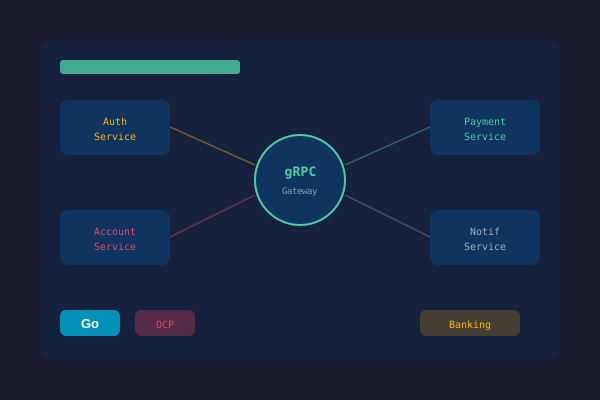
REST and gRPC services designed from the ground up for production load.
- Connection pooling and goroutine management (Go) / thread pool tuning (Java)
- Database query optimization — N+1 detection, proper indexing, query plan analysis
- Caching strategy: Redis for hot data, CDN for static assets, in-memory for configuration
- Rate limiting, circuit breakers, and timeout propagation
- Horizontal scalability from day one — stateless services, externalized session/state
Stack: Go, Java Spring Boot/Quarkus, PostgreSQL, Redis, gRPC, REST
Microservices Architecture
Decomposing monoliths or building distributed systems that don’t become distributed monoliths.
- Service boundary design based on domain, not technical convenience
- Synchronous (gRPC, REST) vs asynchronous (Kafka, RabbitMQ) communication strategy
- Distributed tracing and observability from the start (OpenTelemetry)
- API gateway pattern and service mesh considerations
- Data consistency patterns: saga, outbox, eventual consistency where appropriate
Performance Audits & Bottleneck Removal
Fixing backends that are already in production but underperforming.
- Profiling and flame graph analysis (Go pprof, Java async-profiler)
- Database slow query identification and index strategy
- Memory leak detection and GC tuning
- Load testing with realistic traffic patterns (k6, Gatling)
- Identifying over-engineering — sometimes the fix is removing complexity, not adding it
Financial & Enterprise-Grade Systems
Production experience in regulated, high-stakes environments.
- Transaction integrity and idempotency design
- Audit logging and compliance-ready data handling
- Graceful degradation and fallback patterns
- Zero-downtime deployment strategies (blue-green, canary)
Delivered Results
- Stock trading platform maintenance — Backend work at BCA Sekuritas (2016–2018), one of Indonesia’s largest securities firms
- Loyalty API — Built a loyalty service for a telco client at G2Academy, handling production traffic
- Deployment automation — Multiple clients moved from manual release processes to automated CI/CD pipelines
- Production reliability — Contributed to a high-uptime production system as part of an integration team
Engagement Options
-
Architecture Review — Async review of your system design or codebase with a written findings report and recommendations. Ideal before a major feature build or scaling push.
-
Performance Audit — Load testing, profiling, and bottleneck analysis of your existing backend. Delivered as a prioritized report with implementation guidance.
-
Feature Development (Milestone-Based) — Scoped backend features built to production standard. Fixed price per agreed milestone. Includes tests, documentation, and deployment support.
-
Monthly Engineering Retainer — Dedicated weekly hours for ongoing development, architecture guidance, and code review. Minimum 3-month commitment.
Who This Is For
- Startups hitting their first scaling wall and unsure whether to optimize or rewrite
- Engineering teams preparing for a high-traffic event (launch, campaign, growth push)
- CTOs who need a senior backend engineer without a 6-month hiring process
- Companies running Java monoliths that need to extract performance-critical services into Go
- Fintech, insurance, or e-commerce platforms where backend reliability is non-negotiable
Why Work With Me
- 10+ years in production — BCA Sekuritas, G2Academy, insurance and telco clients since 2016
- Go (90%) + Java (85%) — Deep experience in both, with honest recommendations on which fits your situation
- Architecture-first mindset — I identify the root cause, not just the symptom
- 5 AWS certifications achieved — Backend and cloud are not separate concerns in my work
- Async-friendly — I work well with distributed remote teams and provide written summaries of every significant decision
Next Step
Tell me: what’s your current stack, what load are you handling today, and what does the problem look like? I’ll give you an honest initial assessment in the first call.
Contact: toni@kusnandar.dev or LinkedIn
Pertanyaan yang Sering Diajukan
-
What scale can you handle?
- I've worked on stock trading platform maintenance at BCA Sekuritas, built a loyalty API for a telco client, and architected backend systems for insurance and SaaS platforms. Whether you're at 100 RPS today and planning for growth, or already under load and hitting bottlenecks, I focus on building systems that are maintainable and performant.
-
Go or Java — which do you recommend?
- Depends on your situation. Go is my first choice for new high-throughput services: low memory footprint, fast startup, excellent concurrency primitives. Java (Spring Boot or Quarkus) makes more sense when you have an existing Java ecosystem, need a rich framework for complex business logic, or when your team is already Java-fluent. I'm at 90% in Go and 85% in Java — I'll give you an honest recommendation, not a preference.
-
Can you work on an existing codebase, not just greenfield?
- Yes, and it's often where the highest-impact work is. I can audit your existing backend for performance bottlenecks, identify architectural debt that's limiting throughput, and implement targeted improvements. A full rewrite is rarely necessary — and I'll tell you honestly if it is.
-
What does the engagement model look like?
- For scoped work: fixed-price per milestone. For ongoing development: monthly retainer with dedicated weekly hours. All engagements start with a technical discovery call to validate scope, agree on success metrics, and identify risks before any contract is signed.
Technologies