gRPC vs REST: A Practical Decision Guide for Backend Engineers
A hands-on comparison of gRPC and REST covering performance benchmarks, code examples, tooling, and a clear framework for choosing between them.
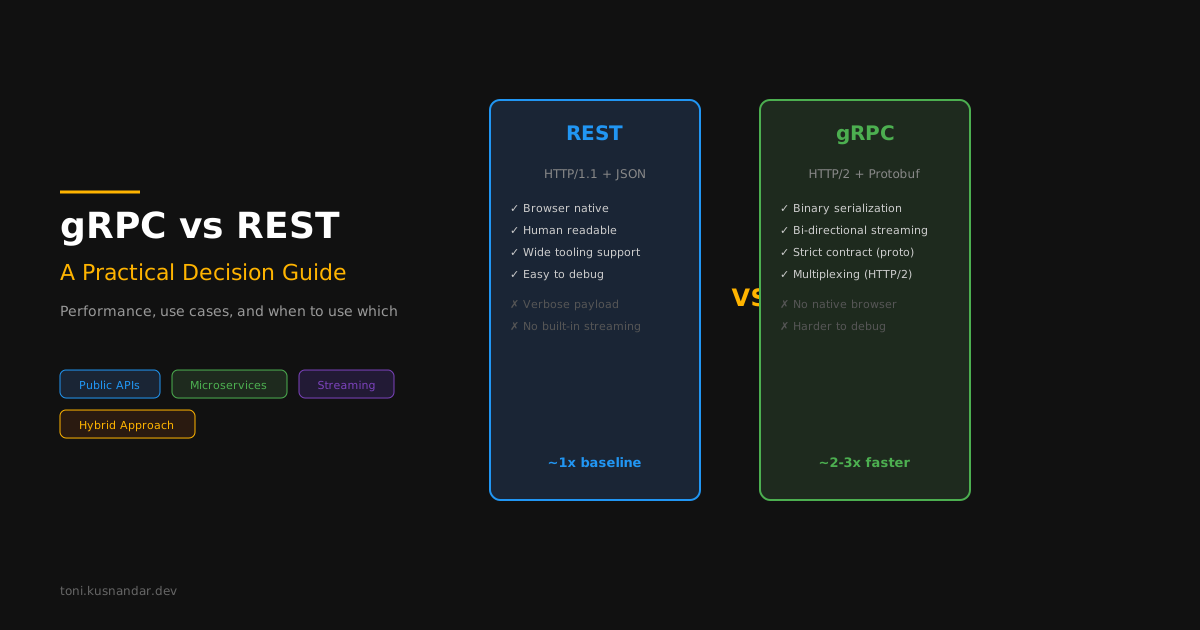
The gRPC vs REST debate generates more heat than light in most engineering discussions. People pick sides based on blog posts and conference talks instead of actual requirements. Let me give you a framework based on building both in production for years.
I have built gRPC services handling millions of internal calls per day and REST APIs serving public clients globally. Both are tools. Neither is universally better. The question is always: “Better for what?”
TL;DR Comparison Table
| Dimension | REST | gRPC |
|---|---|---|
| Protocol | HTTP/1.1 or HTTP/2 | HTTP/2 only |
| Serialization | JSON, XML, etc. | Protocol Buffers (binary) |
| Payload size | Larger (text-based) | 3-10x smaller (binary) |
| Streaming | Limited (SSE, WebSocket separate) | Native bidirectional |
| Browser support | Native | Requires gRPC-Web proxy |
| API contract | OpenAPI/Swagger (optional) | Protobuf (mandatory) |
| Code generation | Optional | Built-in |
| Latency (P50) | ~5-15ms | ~2-8ms |
| Learning curve | Low | Medium |
| Tooling maturity | Excellent | Good (improving) |
| Human readability | High (JSON) | Low (binary) |
| Caching | HTTP caching, CDN | Custom implementation |
| Load balancing | L7 standard | Requires HTTP/2-aware LB |
REST: Strengths and Ideal Use Cases
REST has been the default API style for over a decade. Its strengths are real:
Universal client support. Every programming language, every platform, every tool understands HTTP + JSON. Curl, Postman, browser fetch, mobile SDKs. Zero configuration needed.
Human-readable payloads. When debugging production issues at 2 AM, being able to read the actual request/response in plain text is invaluable. JSON is self-describing.
HTTP caching. GET responses can be cached at every layer: browser, CDN, reverse proxy. This is free performance for read-heavy APIs.
Mature tooling ecosystem. API documentation (OpenAPI/Swagger), testing (Postman), monitoring, rate limiting. Every API gateway speaks REST natively.
Simple mental model. Resources, verbs, status codes. Engineers learn REST in an afternoon and are productive immediately.
When REST is the Right Choice
- Public-facing APIs consumed by external developers
- Browser-to-server communication
- CRUD-heavy applications where payload sizes are small
- APIs that benefit from HTTP caching
- Teams without gRPC experience and tight deadlines
- Services with infrequent inter-service communication
REST: Pain Points at Scale
REST is not without problems, especially in microservice architectures:
No enforced contract. OpenAPI specs are documentation, not enforcement. Nothing prevents a developer from adding a field to the response without updating the spec. Downstream services break silently.
JSON overhead. A 1KB JSON payload might be 200-400 bytes as protobuf. At millions of requests per day, this bandwidth adds up.
No native streaming. Want server-push? Add WebSocket (different protocol, different connection). Want bidirectional streaming? Build it yourself.
Versioning headaches. URL versioning, header versioning, content negotiation. No universal standard, every team does it differently.
N+1 problem. REST resources map to URLs. Getting related data often requires multiple round-trips or complex query parameter schemes.
gRPC: Strengths and Ideal Use Cases
gRPC was designed by Google for internal service communication. Its strengths reflect that origin:
Strict API contracts. Protobuf definitions ARE the contract. You cannot deploy a breaking change without the compiler catching it. This alone prevents entire categories of production incidents.
Efficient serialization. Protocol Buffers encode data in binary format. 3-10x smaller than JSON for equivalent data structures. Serialization/deserialization is 5-10x faster.
Native streaming. Four communication patterns out of the box:
- Unary (request-response, like REST)
- Server streaming (one request, stream of responses)
- Client streaming (stream of requests, one response)
- Bidirectional streaming (both sides stream simultaneously)
Automatic code generation. Define your API in .proto files, generate type-safe client and server code in any language. Go, Java, Python, TypeScript, C++, Rust.
HTTP/2 multiplexing. Multiple RPC calls share a single TCP connection. No head-of-line blocking. Connection setup cost is amortized.
When gRPC is the Right Choice
- Internal service-to-service communication
- High-throughput data pipelines
- Real-time streaming requirements
- Polyglot microservice environments
- Services where API contract enforcement is critical
- Large payload transfers where serialization efficiency matters
Performance Comparison
Real benchmarks from identical Go services, same hardware, same business logic:
Unary Call (Single Request-Response)
| Metric | REST (JSON) | gRPC (Protobuf) |
|---|---|---|
| P50 latency | 4.2ms | 1.8ms |
| P99 latency | 12ms | 5.5ms |
| Throughput (single conn) | 2,400 RPS | 5,800 RPS |
| Payload size (1 user) | 312 bytes | 89 bytes |
| Serialization time | 1.2us | 0.3us |
| Memory per request | 4.1KB | 1.8KB |
Bulk Transfer (1000 items)
| Metric | REST (JSON) | gRPC (Server Stream) |
|---|---|---|
| Total transfer time | 45ms | 12ms |
| Payload size | 312KB | 89KB |
| Memory peak | 2.4MB | 0.6MB |
| Time to first item | 45ms | 1ms |
The streaming advantage is massive. With REST, the client waits for the entire response. With gRPC server streaming, the client starts processing the first item within milliseconds.
Code Comparison: Same Endpoint in Both
Let me show the same user service implemented in both, so you can compare the developer experience.
Protobuf Definition (gRPC)
syntax = "proto3";

package user.v1;

option go_package = "github.com/myorg/myapi/gen/user/v1";

service UserService {
  rpc GetUser(GetUserRequest) returns (GetUserResponse);
  rpc ListUsers(ListUsersRequest) returns (stream User);
  rpc CreateUser(CreateUserRequest) returns (CreateUserResponse);
}

message GetUserRequest {
  string id = 1;
}

message GetUserResponse {
  User user = 1;
}

message User {
  string id = 1;
  string name = 2;
  string email = 3;
  int64 created_at = 4;
}

message ListUsersRequest {
  int32 page_size = 1;
  string page_token = 2;
}

message CreateUserRequest {
  string name = 1;
  string email = 2;
}

message CreateUserResponse {
  User user = 1;
}
gRPC Server Implementation (Go)
package grpc

import (
    "context"

    pb "github.com/myorg/myapi/gen/user/v1"
    "github.com/myorg/myapi/internal/service"
    "google.golang.org/grpc/codes"
    "google.golang.org/grpc/status"
)

type UserServer struct {
    pb.UnimplementedUserServiceServer
    svc *service.UserService
}

func (s *UserServer) GetUser(ctx context.Context, req *pb.GetUserRequest) (*pb.GetUserResponse, error) {
    user, err := s.svc.GetByID(ctx, req.GetId())
    if err != nil {
        return nil, status.Errorf(codes.NotFound, "user not found: %v", err)
    }

    return &pb.GetUserResponse{
        User: &pb.User{
            Id:        user.ID,
            Name:      user.Name,
            Email:     user.Email,
            CreatedAt: user.CreatedAt.Unix(),
        },
    }, nil
}

func (s *UserServer) ListUsers(req *pb.ListUsersRequest, stream pb.UserService_ListUsersServer) error {
    users, err := s.svc.List(stream.Context(), int(req.GetPageSize()), req.GetPageToken())
    if err != nil {
        return status.Errorf(codes.Internal, "listing users: %v", err)
    }

    for _, user := range users {
        if err := stream.Send(&pb.User{
            Id:    user.ID,
            Name:  user.Name,
            Email: user.Email,
        }); err != nil {
            return err
        }
    }
    return nil
}
REST Equivalent (Go with Chi)
package handler

import (
    "encoding/json"
    "net/http"

    "github.com/go-chi/chi/v5"
    "github.com/myorg/myapi/internal/service"
)

type UserHandler struct {
    svc *service.UserService
}

func (h *UserHandler) GetUser(w http.ResponseWriter, r *http.Request) {
    id := chi.URLParam(r, "id")

    user, err := h.svc.GetByID(r.Context(), id)
    if err != nil {
        writeError(w, http.StatusNotFound, "user not found")
        return
    }

    writeJSON(w, http.StatusOK, map[string]interface{}{
        "user": map[string]interface{}{
            "id":         user.ID,
            "name":       user.Name,
            "email":      user.Email,
            "created_at": user.CreatedAt,
        },
    })
}

func (h *UserHandler) ListUsers(w http.ResponseWriter, r *http.Request) {
    pageSize := queryInt(r, "page_size", 20)
    pageToken := r.URL.Query().Get("page_token")

    users, err := h.svc.List(r.Context(), pageSize, pageToken)
    if err != nil {
        writeError(w, http.StatusInternalServerError, "failed to list users")
        return
    }

    writeJSON(w, http.StatusOK, map[string]interface{}{
        "users": users,
    })
}

func writeJSON(w http.ResponseWriter, status int, data interface{}) {
    w.Header().Set("Content-Type", "application/json")
    w.WriteHeader(status)
    json.NewEncoder(w).Encode(data)
}
Notice: the business logic layer (service.UserService) is identical. Only the transport layer differs. This is the key architectural pattern that enables the hybrid approach.
Hybrid Approach: REST External, gRPC Internal
This is what I recommend for most production systems and what I implement in my production Go API projects:
External Clients (browsers, mobile apps, third-party)
    │
    ▼
[API Gateway / REST Handler]
    │
    ▼
[Service Layer - shared business logic]
    │
    ▼ (gRPC)
[Internal Services: Auth, Payments, Notifications]
Benefits:
- External clients get familiar REST + JSON
- Internal communication gets gRPC efficiency
- Single business logic layer, two transport layers
- Migrate incrementally without breaking external clients
Running Both Protocols
func main() {
    // Shared dependencies
    svc := service.NewUserService(repo)

    // REST server
    restHandler := handler.NewUserHandler(svc)
    restRouter := handler.NewRouter(restHandler)
    restServer := &http.Server{Addr: ":8080", Handler: restRouter}

    // gRPC server
    grpcServer := grpc.NewServer()
    pb.RegisterUserServiceServer(grpcServer, grpcHandler.NewUserServer(svc))
    grpcListener, _ := net.Listen("tcp", ":9090")

    // Run both
    go restServer.ListenAndServe()
    go grpcServer.Serve(grpcListener)

    // Graceful shutdown for both...
}
Migration Strategy: Adding gRPC to Existing REST
If you have an existing REST service and want to add gRPC:
Phase 1: Define protobufs for your most-called internal endpoint. Pick the service-to-service path with the highest call volume. This is where gRPC provides the most benefit.
Phase 2: Generate code and implement the gRPC server alongside REST. Same service layer, new transport. Deploy with both protocols active.
Phase 3: Migrate one internal caller to use gRPC. Measure the improvement in latency and throughput.
Phase 4: Gradually migrate remaining internal callers. Keep REST for all external communication.
Do not attempt to convert everything at once. The incremental approach lets you validate benefits before committing fully.
Tooling Ecosystem Comparison
| Tool Category | REST | gRPC |
|---|---|---|
| API documentation | Swagger UI, Redoc | buf.build, grpcui |
| Testing | Postman, curl, httpie | grpcurl, BloomRPC, Postman |
| Load testing | k6, wrk, vegeta | ghz, k6 (with extension) |
| Monitoring | Any APM tool | OpenTelemetry, gRPC interceptors |
| API gateway | Kong, AWS API GW, Envoy | Envoy, gRPC-gateway |
| Code generation | openapi-generator | protoc, buf |
| Schema validation | JSON Schema | Protobuf compiler |
| Mocking | WireMock, Mockoon | grpc-mock, buf |
REST tooling is more mature and accessible. gRPC tooling has caught up significantly in the past 2 years, especially with buf.build making protobuf management much simpler.
My Recommendation
After building both extensively, here is my simple decision framework:
Use REST when:
- Your API is consumed by browsers or external developers
- You need HTTP caching or CDN support
- Your team has no gRPC experience and you are on a deadline
- Payload sizes are small and call frequency is moderate
Use gRPC when:
- Services call each other thousands of times per second
- You need streaming (real-time updates, bulk data transfer)
- API contract enforcement is critical for reliability
- You have a polyglot environment and need shared API definitions
Use both when:
- You have external clients AND internal microservices
- You want to migrate incrementally without breaking existing integrations
- Different workloads have different requirements within the same system
The wrong answer is picking gRPC because it sounds modern without having a concrete performance or streaming requirement. The other wrong answer is sticking with REST for internal communication when you are making 10,000 inter-service calls per second and paying for JSON serialization overhead.
Need help deciding on the right communication patterns for your architecture? I offer technical consultation where we analyze your traffic patterns and design the optimal protocol strategy for your specific system.
See gRPC applied in production context in my Go gRPC service portfolio project.